
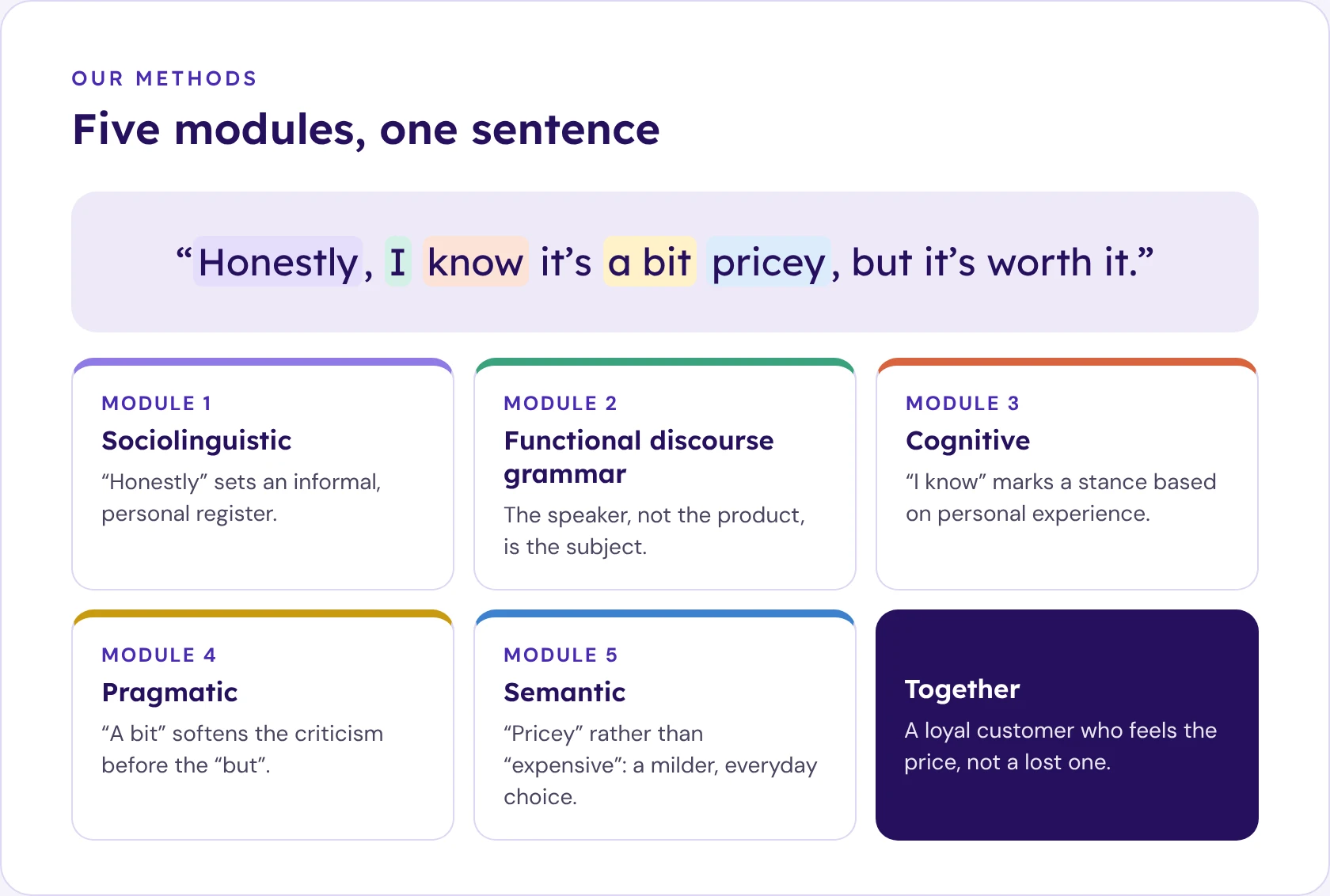
Five modules, one goal: making the thinking inside language visible. Linguistics is made up of subfields that study language at different levels. We have turned each of these into an analysis module adapted for market research. Each module answers a different question; used together, they offer a multi-dimensional view of the consumer’s mind.
Module 1: Sociolinguistic Analysis
Language is as social as it is individual. The way a person speaks is shaped by their age, gender, education, social status, the groups they belong to and the setting they are in. Even a simple greeting tells us a great deal about the speaker’s background and the context of the conversation:
- “Good morning, sir.”
- “How do you do?”
- “Hello, how are you?”
- “Hiya, love!”
- “Alright, mate?”
Forms of address work in a similar way. Calling someone by their first name rather than “Mr Smith”, or, in languages such as French, German or Turkish, choosing the informal “you” (tu, du, sen) over the formal one (vous, Sie, siz), can signal closeness, an attempt to remove a power difference, or even a deliberate act of rudeness or distance.
The central question of sociolinguistics is this: although all humans share the same capacity for language, why does language use differ between women and men, young and old, or groups with different levels of education? William Labov’s work showed that these differences are not deficits but differences: language within a society is not uniform but varied. This perspective makes it possible to identify the linguistic features of different consumer segments and to build the right communication strategy for each.
An example
Mothers and fathers describe their children in noticeably different ways. Mothers use possessive forms (“my baby”, “my little boy”) far more often, while fathers tend to say “the baby” and describe the child through measurable facts such as weight or age in months:
My baby has just turned seven months. We’re starting on solids for the first time.
Mother
The baby was 3,390 grams at birth. Then it dropped to 3,200…
Father
This suggests that the mother experiences the child as part of herself, while the father sees the child as a separate being. Addressing mothers and fathers in the same way in communication about baby products may therefore mean leaving one of them out.
This module answers questions such as:
- Which linguistic features reveal the consumer’s identity?
- What kind of linguistic world does the consumer place themselves in?
- Which linguistic units distinguish different consumer groups?
- Where does the consumer sit in the social hierarchy, and where do they aspire to be?
Module 2: Functional Discourse Grammar Analysis
Functional approaches to grammar study how grammatical structures help to create meaning. In this tradition, which runs from Simon C. Dik’s Functional Grammar to Hengeveld and Mackenzie’s Functional Discourse Grammar and draws on the work of Halliday and Givón, an utterance has three core components: a conceptual component carrying the communicative intention, a grammatical component that puts this intention into words, and a contextual component covering the conditions in which the utterance is produced.
The grammatical structures we choose without thinking reflect our implicit attitudes. A small change in structure can change the meaning considerably:
- She remembers her daughter going to school. (an activity she recalls)
- She remembers that her daughter went to school. (a fact she knows)
Word order works in the same way. The sentences below contain almost the same words, but each puts a different piece of information in the spotlight:
- What Emma read was Tom’s red book.
- The book Emma read, Tom’s, was red.
- The red book Emma read was Tom’s.
Choices about agency and responsibility are equally revealing:
- I didn’t send the file. (taking responsibility)
- The file didn’t get sent. (presenting it as something that just happened)
When people speak or write, they automatically choose the structures that best reflect their attitude, without being aware of it. Analysing grammatical structures is therefore a powerful way to uncover a consumer’s real attitude towards a product or service. (You can find an application of this module to exercise habits on the From Our Research page.)
This module answers questions such as:
- Which grammatical structures does the consumer choose when describing their experience of a product or service?
- How are differences in the perception of competing products reflected in grammar?
- Which grammatical structures characterise different consumer groups, and what lies behind them?
- How is the product or service structured in the consumer’s mind?
- Which grammatical structures should new communication and strategy use?
Module 3: Cognitive Linguistics and Cognitive Perception Analysis
Every thought is ultimately expressed in language. Cognitive linguistics, which took shape from the 1970s onwards through the work of researchers such as George Lakoff, Ronald Langacker, Leonard Talmy and Zoltán Kövecses, studies how the outside world is represented in the mind and how this representation is reflected in language. Language is a cognitive phenomenon: our entire cognitive machinery is at work when we encode and use it.
Conceptual metaphors and root ideas
According to cognitive linguistics, our everyday conceptual system is fundamentally metaphorical. When we say “prices rose”, “the pound fell” or “shares have hit rock bottom”, it is no accident that an increase is expressed by going up and a decrease by going down. Our minds hold an encoding that MORE IS UP and LESS IS DOWN. That is also why we feel “high” when things go well and “down” when they do not.
We call encodings like these root ideas. Root ideas form as societies develop, and individuals acquire them along with language in everyday life. Identifying a root idea means understanding how a topic is built in the mind and what behaviour it leads to. Beyond that, it makes it possible to determine which linguistic structures should be used, and how, to change an existing root idea.
One word, several mental schemas
Cognitive linguistics is very effective at identifying the building blocks of a concept. Every linguistic concept rests on a base and is produced within a domain. In Turkish, for example, the verb çekmek means both “to pull or tow” and “to get a signal” (as a phone does). When a telecoms brand combined these two domains, saying in effect “our network pulls like a powerful car tows a heavy load”, several schemas linked to the same concept were triggered at once, so the message left a stronger trace in the mind.
However, poorly designed conceptual mappings can create unwanted side meanings. Equating the network with an off-road vehicle reinforced not only the idea that “it works in any conditions” but also the idea that “it must be expensive”. Well-designed mappings, on the other hand, produce strong propositions that set a brand apart from its competitors.
Subjectivity and stance
By tracking how subjectivity is encoded in a text, we can reveal a consumer’s linguistic stance towards a brand, and so how they position themselves in relation to it. (See our supermarket study on the From Our Research page.)
This module answers questions such as:
- In which bases and domains are perceptions of a product or service produced?
- How do these perceptions differ between consumer groups?
- How does the consumer reconstruct the product in their mind, and how is this reflected in language?
- Which structures will leave a lasting trace in the consumer’s mind?
Module 4: Pragmatic Analysis
While sociolinguistics looks at the social dimension of language, pragmatics focuses on how individuals use it. People do not always express their thoughts, feelings and attitudes openly; often the real message is left implicit. Pragmatics studies this hidden layer beneath the surface of language and how listeners draw on real-world knowledge to interpret what is said. It is concerned not with rules but with use, and not with dictionary meanings but with speakers’ strategies.
| What is said | What is meant |
|---|---|
| “It’s warm in here, isn’t it?” | “Could you open the window?” |
| “Smile, you’re on camera.” | “We’re watching you, so don’t steal anything.” |
| “You got the scholarship? I’m so happy for you.” | “It’s not great news for me.” |
Pragmatic analysis can show, for example, that consumers use avoidance strategies even when saying certain brand names, the psychological distance they put between themselves and a brand, or whether they say “I” or “we” when describing a relationship.
This module answers questions such as:
- Which expressions reflect the consumer’s individual preferences?
- What implicit attitudes has the consumer developed towards the product or service?
- What is the consumer’s line of thinking about the product?
- How does the consumer express the bond with, or distance from, the product in language?
Module 5: Semantic Analysis
Semantics studies meaning, especially at the level of words. Words are the most basic building blocks of thought, so the words people choose largely shape their attitude to a topic. Analysing the relationships between words and their components of meaning shows what kind of world of meaning a perception is formed in.
Even words that look like synonyms open onto different worlds. Describing the same behaviour as “thrifty”, “economical” or “stingy” reveals three very different evaluations. In the same way, a customer who calls a product “cheap” rather than “affordable” or “good value” is telling us something important about how they see it.
This module answers questions such as:
- Which words reflect the consumer’s attitude towards the product or service?
- What network of meaning links these words?
- Within which lexical field does the consumer perceive the product?
- Which semantic strategies would make the product stand out?
How We Work
Every project starts with defining, together with our client, the questions to be answered, and ends with a practical strategy recommendation.
- Defining the key questions. We agree the aim of the research and the questions to be answered. At this stage we also decide which of the five modules to apply.
- Collecting data. We select the sources best suited to the research question from focus group and in-depth interview transcripts, call-centre recordings, emails, texts written by participants and social media data. In many cases we can work with the data you already have, without new fieldwork.
- Identifying linguistic structures. We identify the structures that reflect explicit and implicit attitudes in the data, and we detect metaphors using systematic, replicable methods such as the Metaphor Identification Procedure (MIP).
- Quantitative and qualitative analysis. Using qualitative data analysis software such as MAXQDA and corpus tools such as AntConc, we quantify the structures we have identified and compare them within and between groups.
- Mapping source and target domains. We work out which source domain (for example, a JOURNEY) each metaphor maps onto which target domain (for example, LOVE).
- In-depth analysis. From the analysed data, we identify the root ideas and the linguistic structures that feed them.
- Results and strategy. We present the building blocks of a new strategy that either works with the root ideas or aims to change them, together with the linguistic structures to use and to avoid in communication.