
How does language reveal what is hidden in the data? A few examples from our work.
In line with our confidentiality agreements, brand and client names are not given in the studies below. Participant quotes have been anonymised and translated from the original Turkish.
Mothers and Breastfeeding: “Breast milk = me”
Modules: semantics, functional discourse grammar · Data: mothers’ written and spoken accounts
Question: How do mothers describe breastfeeding, and how does their language change depending on whether it is going well or badly?
Finding: When breastfeeding goes well, mothers mostly place themselves as the subject of the sentence (“I’m breastfeeding.”). When there is a problem, the subject changes: mothers attribute the problem to something outside themselves, most often to the milk.
| Active participant in the sentence | Example | Share |
|---|---|---|
| Going well: the mother | “I breastfed my children healthily.” | 50% |
| Going well: the milk | “She’s fed on breast milk only.” | 28% |
| Going well: the baby | “She wakes twice a night, feeds and goes back to sleep.” | 22% |
| Problems: the milk | “She’s nine months old and won’t take breast milk.” | 67% |
| Problems: the baby | “She hasn’t fed at night for three days.” | 23% |
| Problems: the mother | “I can’t breastfeed because of the antibiotics.” | 10% |
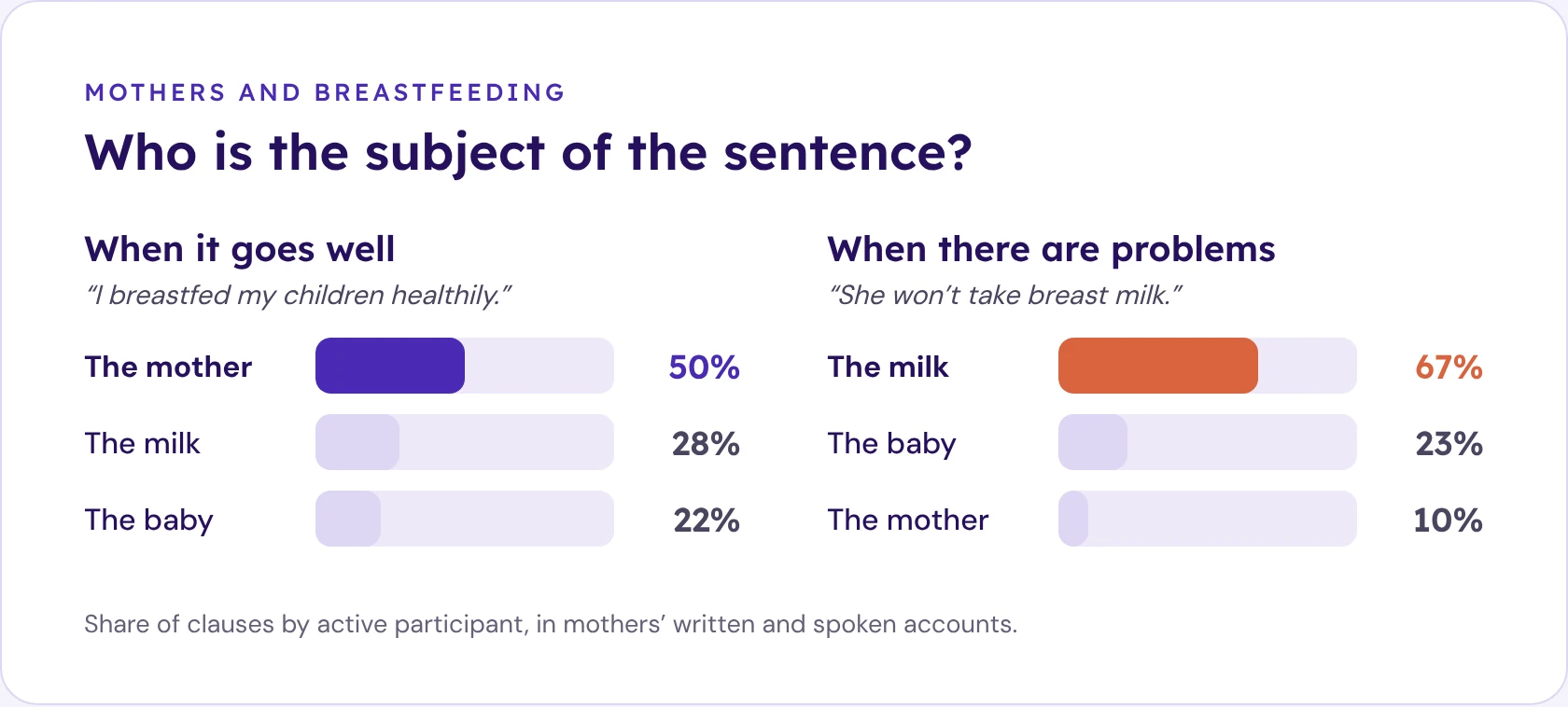
What it means: Breastfeeding makes the mother an active agent, and mothers who breastfeed feel stronger. When it goes well, breast milk is identified with the mother herself: “Our milk is enough” really means “I am enough”. When problems arise, breast milk turns into one category of milk among others, like “follow-on milk” or “growing-up milk”, and the mother separates herself from it. This distinction directly shapes which language should be used with mothers, and when.
Supermarket Perception: One judgement, three stances
Modules: cognitive linguistics (subjectivity and stance), pragmatics · Data: in-depth interviews
Question: How do consumers who do not shop at a national supermarket chain see that supermarket?
Finding: At first sight, the three participants who did not shop at the supermarket seemed to make the same judgement. Their linguistic stances, however, were very different:
| Statement | Stance | What it tells us |
|---|---|---|
| “Supermarket X is very expensive.” | Factual (like “two plus two is four”) | The group furthest from the brand; they do not see themselves as active shoppers there. |
| “I know supermarket X is expensive.” | Personal experience | Based on their own experience; they can see themselves as active shoppers. |
| “My upstairs neighbour says meat is expensive at supermarket X.” | Reported | No personal experience, but not a factual stance either; their view is shaped by someone else’s account. |
Pragmatic analysis completed the picture. When talking about discount supermarkets, participants rarely hesitated, but when naming the large supermarket chains their use of hesitation and filler words (the Turkish equivalent of “um” or “what’s-it-called”) rose sharply. Participants paused even when saying the brand name, a sign of avoidance.
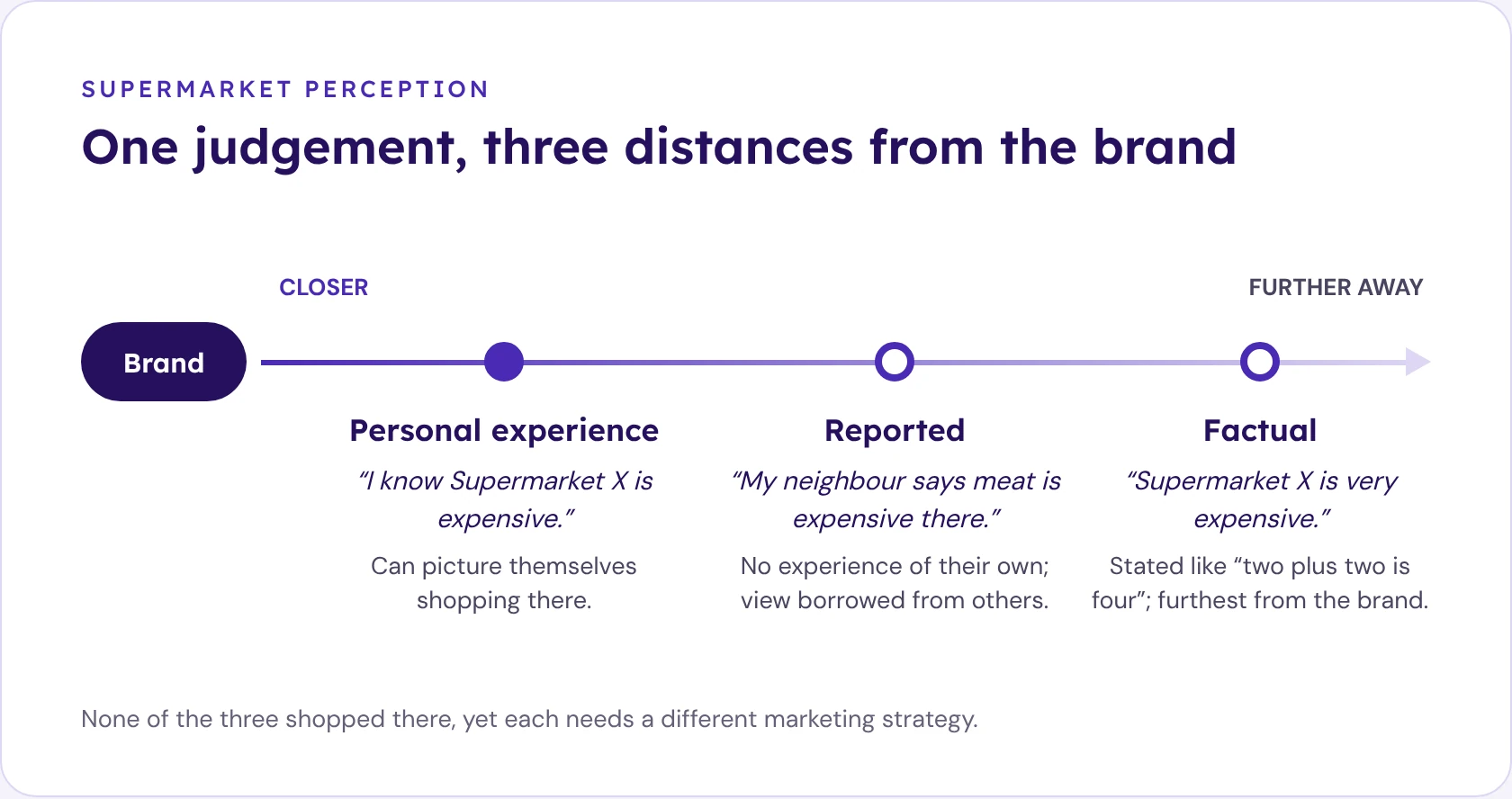
What it means: None of them shopped at the supermarket, yet they were not equally distant from it, so each group needs a different marketing strategy. There was also a psychological distance between these consumers and the large chains, reflected even in the way they said the brand names.
Women and Exercise: “When I exercise, I’m the person I want to be.”
Modules: functional discourse grammar, semantics · Data: texts in which women described their experiences of exercise
Question: What leads women to exercise regularly, and what lies behind giving it up?
Finding 1: Exercise and identity. In clauses describing what happens “while” exercising, women linked exercise to personality traits. For them, exercise is a time to be alone with themselves and to meet the person they want to be:
When I’m exercising, I’m ambitious, excited, dynamic, someone who never gives up and always finishes what she starts.
Walking gives me time alone with myself. It’s one of the rare moments in my daily life when I can be on my own.
Finding 2: Ongoing versus finished. Women who exercised regularly described their workouts far more often with continuous forms, the kind of language that places you inside an ongoing action (“I’m running, I’m breathing, I’m getting stronger”). Women who exercised irregularly described exercise as finished and used up (“I went, I did it, it was hard”). Being unable to picture yourself in the middle of exercise was directly linked to giving it up.
Finding 3: Sharing, not competing. Semantic analysis showed that women associated exercise not with words such as “ambition”, “medal”, “winning” or “beating others”, but with sharing-based words such as “togetherness”, “team”, “friendship” and “socialising”. This matched their preference for non-competitive activities such as fitness classes, walking, Pilates and running.
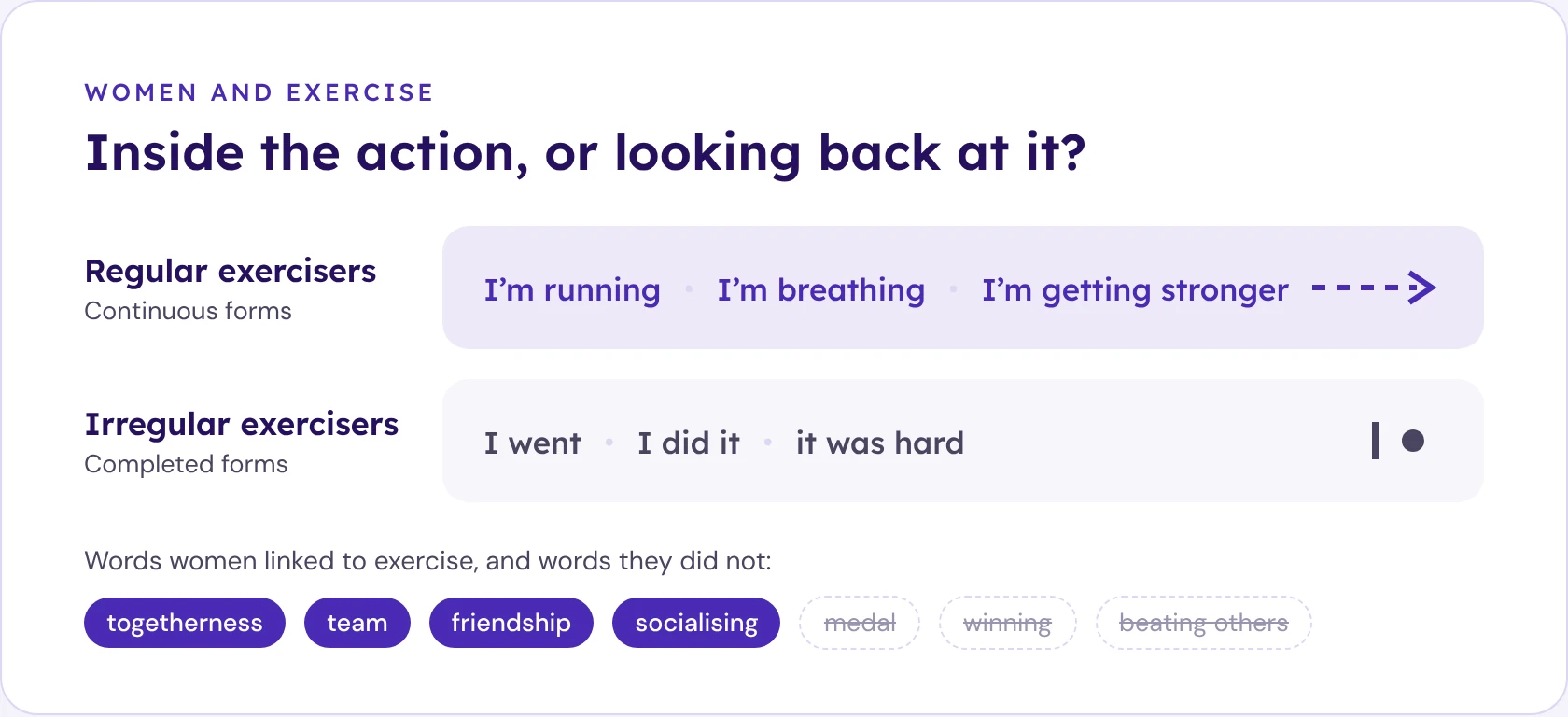
What it means: Communication that encourages women to exercise should present it as something ongoing rather than finished, help women picture themselves in the middle of the activity, and emphasise sharing and togetherness rather than competition.
Beauty and Cosmetics: “What is beautiful is at the front.”
Module: cognitive linguistics (conceptual metaphor analysis, MIP) · Data: in-depth interviews
Question: How do women conceptualise beauty and cosmetics?
Finding: Metaphor analysis revealed several strong root ideas about beauty and cosmetics:
- BEAUTY IS AT THE FRONT, UGLINESS IS AT THE BACK. “It’s about bringing your best features forward and pushing the weaker ones into the background.”
- BEAUTY IS STILLNESS. Beauty is described as a calm, lasting state.
- BEAUTY IS ATTRACTION. Beauty draws people in like a magnetic field.
- COSMETICS ARE A FORCE, A PATH AND A REPAIR. Cosmetics push forward, take you somewhere and fix things, but “overdoing it” backfires.
- MAKE-UP IS A WEIGHT. Make-up is encoded as a load added to the surface and carried.
A detailed analysis by area of the face also gave concrete pointers for product development:
- Face: Described not with active verbs such as “looking” but with passive ones such as “being seen” or “appearing”. The face is the focus of communication; the more it is noticed, the closer the connection.
- Eyes: The focal point of the face. Participants did not speak of “face make-up” or “lip make-up”, but named “eye make-up” as a category of its own. We recommended positioning eye products as “eye-defining”.
- Brows: Almost always mentioned together with the eyes and linked to the gaze. Brow products should highlight their effect on the way one looks at others.
- Skin: Conceptualised as a living structure that breathes (“I can feel my skin breathing.”). Heavy foundation is therefore seen as something that stops the skin from breathing.
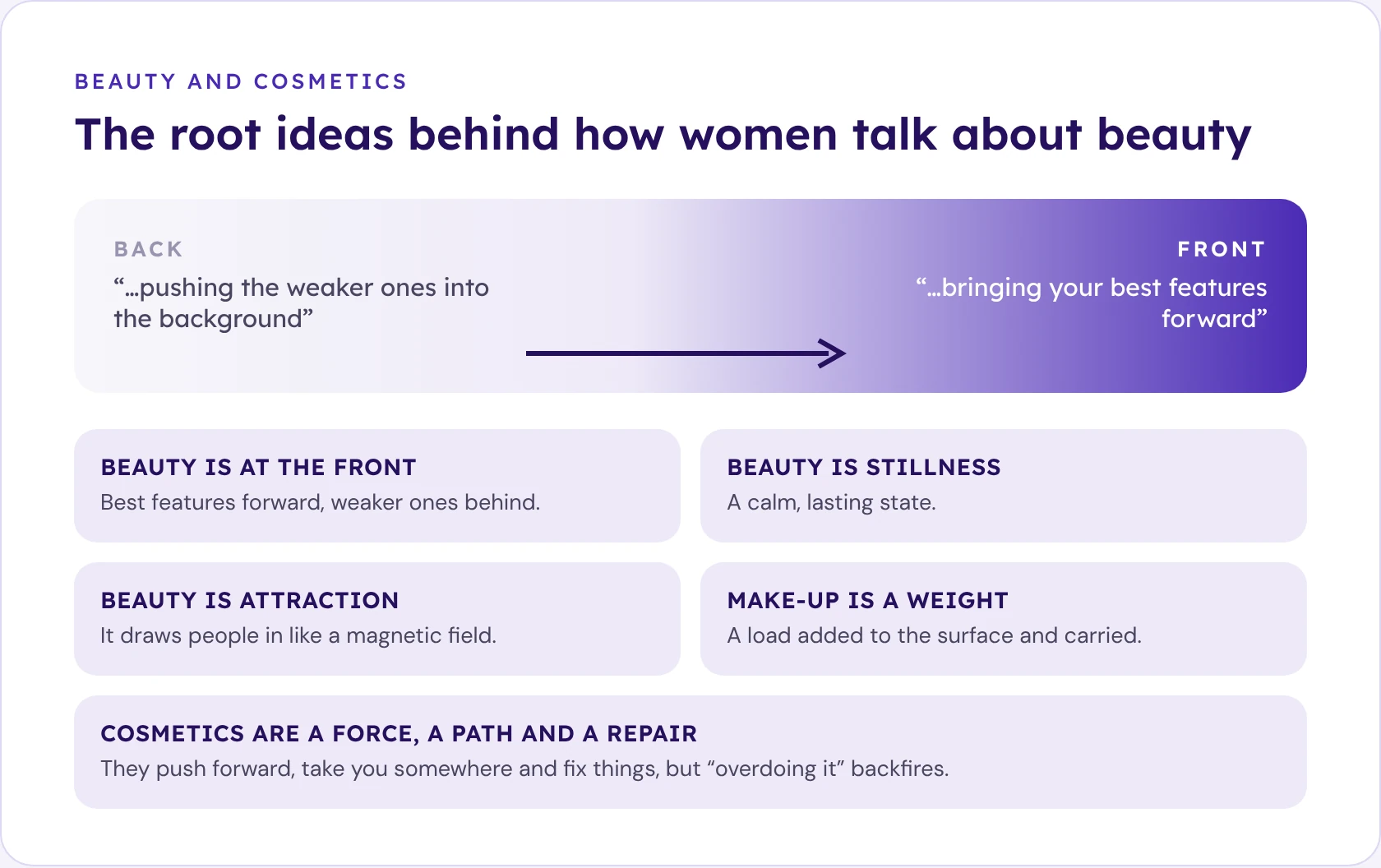
What it means: Once these root ideas were identified, we set out how communication and product positioning should be built around them.
Related publication: Aygüneş, M. (2022). Güzellik Sadece Güç müdür? Derlem Tabanlı Bir Metafor İncelemesi [Is Beauty Just Force? A Corpus-Based Metaphor Analysis]. Dilbilim Araştırmaları, 33(2), 247–280. A peer-reviewed study (in Turkish) of how beauty is conceptualised in a 73,000-word corpus of Turkish texts, finding that beauty is framed mainly as a physical object and, less often, as force.
Young People and Love: Concrete women, abstract men
Modules: sociolinguistics, pragmatics · Data: narratives written by university students
Finding 1: Men described love through abstract concepts such as “peace”, “happiness” and “affection”, while women linked it to concrete things such as “eyes”, “shaking legs”, “tears” and “chocolate”. Women connected happiness and excitement to concrete expectations such as gifts and surprises:
The present really was for me. Someone had gone to a bookshop and chosen a book just for me.
Female participant
Once you have the one you longed for, love fades as the excitement ends; what remains is a mixture of nostalgia, affection and habit.
Male participant
Finding 2: When telling their stories, women mostly used “I” and “he/she”, while men used “we”. Women saw themselves and their partners as separate people, whereas men’s “we” absorbed the partner; in a sense, “we” was a more acceptable form of “I”.
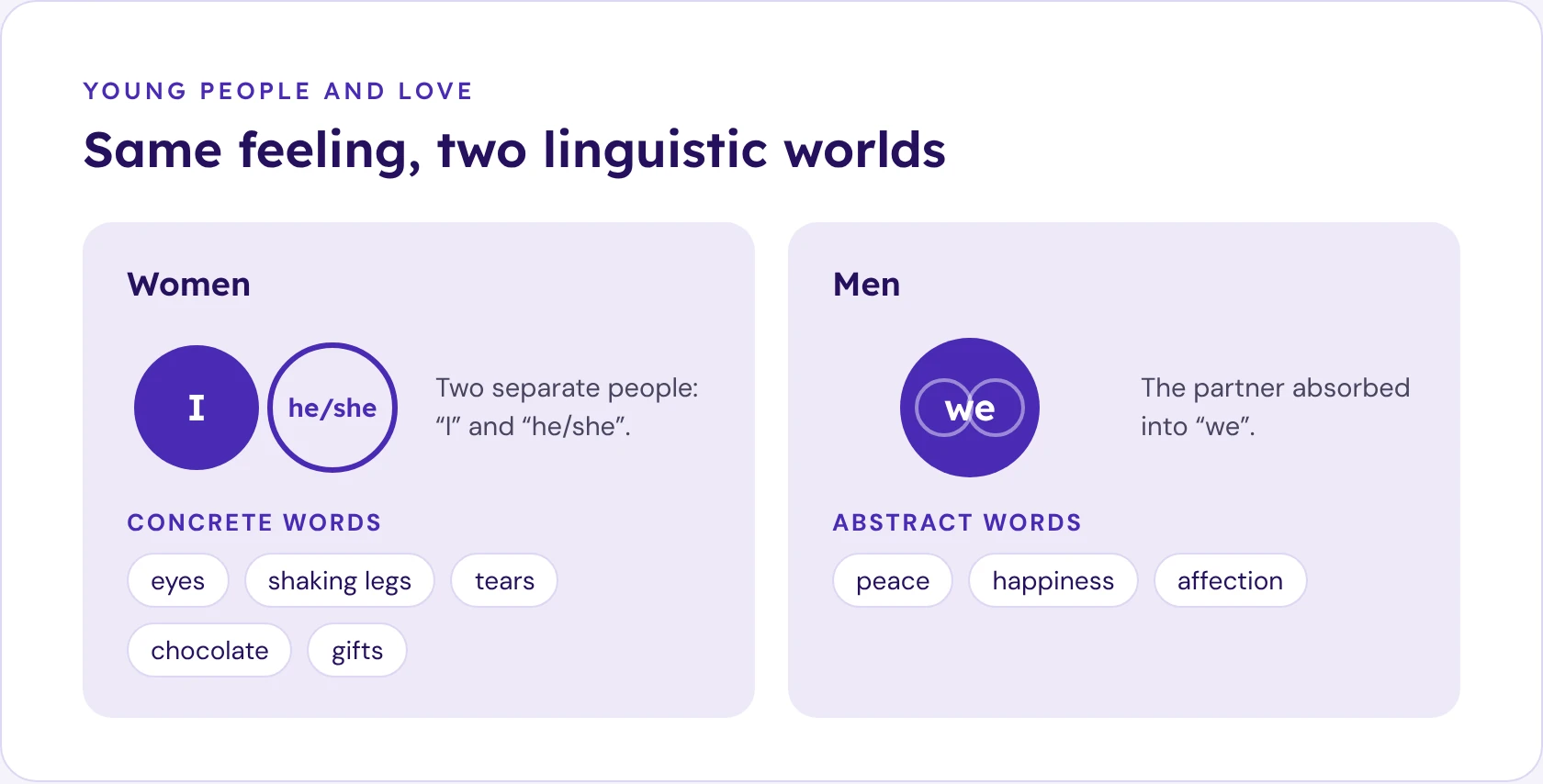
What it means: These two groups approach the same feeling from two different linguistic worlds. Addressing both with the same message means fully reaching neither.