
Linguistics is the scientific study of language from many angles: from sounds and grammar to meaning, from how language is processed in the brain to how it is used in society.
What linguistics is not
- Linguistics is not literature. It is not the same as studying English or any other literature. Linguistics is concerned with language itself, not with literary texts.
- Linguistics is not neuro-linguistic programming (NLP). Despite the similar name, neuro-linguistic programming is not a scientific field of linguistics.
- You don’t need to speak many languages to be a linguist. A linguist is a scientist who studies how language works, not necessarily a translator or a polyglot.
An experiment: the balloon and the house
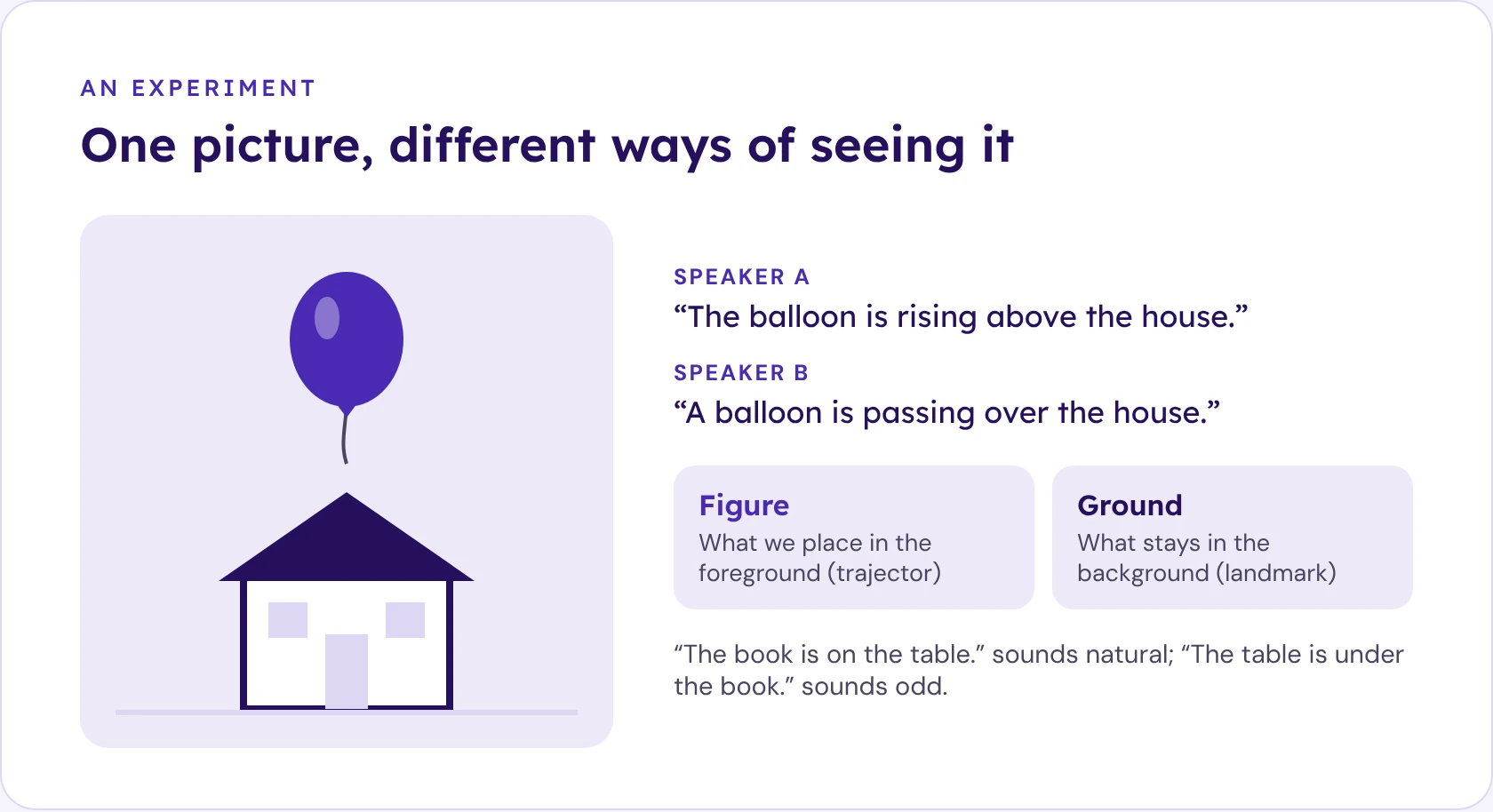
Imagine a picture of a balloon floating above a house, and try describing it in one sentence. Some people say, “The balloon is rising above the house.” Others say, “A balloon is passing over the house.” The same picture is conceptualised differently in different minds: one person places the balloon in the foreground (the figure, or trajector) and the house in the background (the ground, or landmark), while another directs attention elsewhere.
This is also why “The book is on the table.” sounds natural, while “The table is under the book.” sounds odd. How we perceive the world is inevitably reflected in language.
The metaphors we live by
Metaphor is not just a tool for poets. Cognitive linguistics studies the conceptual metaphors that form the building blocks of our thinking and that we use constantly in everyday language:
| Everyday expressions | Conceptual metaphor |
|---|---|
| “That theory is groundless.” · “Your argument needs more support.” · “We need a solid foundation.” | IDEAS ARE BUILDINGS |
| “The company is growing.” · “The investment is bearing fruit.” · “We’re branching out.” | ORGANISATIONS ARE PLANTS |
| “Your claims are indefensible.” · “Her criticism hit the target.” · “I demolished his argument.” | ARGUMENT IS WAR |
| “Our relationship is going nowhere.” · “We went our separate ways.” · “We’re at a crossroads.” | LOVE IS A JOURNEY |
| “The two novels have many parallels.” · “These two colours are very close.” | SIMILARITY IS CLOSENESS |
Imagine a culture where argument is understood not as war but as a dance. In that culture, nobody would win or lose an argument; attacking, defending and retreating would have no meaning, and arguing itself would become something entirely different. Metaphors shape not only how we speak, but how we think and act.
A metaphor maps two domains onto each other: the target domain we are trying to explain (LOVE) and the source domain we use to explain it (A JOURNEY). Lovers correspond to travellers, problems in the relationship to obstacles on the road, and the couple’s goals to the destination. When someone sees a topic negatively, the source domain fills with negative elements too: for someone who places little value on love, LOVE IS A JOURNEY becomes a broken, winding road full of potholes.
Language and being: two philosophers
Language shapes not only how we speak, but how we experience the world and how we relate to ourselves.
Martin Heidegger: “Language is the house of being.”
For Heidegger, language is not merely a tool for communication but the space in which human beings make sense of the world and express themselves. We grasp the world through language and find our place within it.
Hans-Georg Gadamer: “Being that can be understood is language.”
For Gadamer, language sets the horizon of human experience: to understand something is to be able to put it into words. Language is the ground not only for expressing thought but for thought itself.
What unites these two thinkers is the idea that language lies at the heart of human existence. We use language not only to describe the world, but to understand, interpret and structure it.
Language is the foundation of communication design
We believe that every unit of language carries depth of meaning. The social and cognitive dimensions of language give our work a human-centred perspective.
- Every word is a choice, and every choice tells a story. Every linguistic structure is a choice that shapes thought and guides emotion. Semantics shows how a single word can rewrite a story.
- Language reveals what is implicit. Through a pragmatic lens, we can see the intentions, attitudes and expectations beneath what is said.
- Language creates closeness and distance. A simple choice, such as using a first name or a title, shapes power relations, social bonds and the tone of communication.
- Meaning lies in difference. As sociolinguistics shows, language is not uniform: the way different groups use language expresses not only communication but identity and belonging.
- Grammar is the architecture of communication. Well-chosen structures and word order make a message clearer, more coherent and more effective.
- From the local to the universal. Well-crafted language can respect local identities while carrying a universal message.
- Language is strategy. Language is used not only to describe, but to move people to act and to shape their decisions.